
The Stella Case: When Reinvestment Costs Fall Short of 'Disturbance'
The Stella Case: When Reinvestment Costs Fall Short of 'Disturbance'In the complex world of compulsory acquisition, the principle of equivalence is the central doctrine governing the assessment of loss. Equivalence is the notion that a dispossessed owner should be compensated fairly and fully, being put back in the same position they would have been in had their land not been compulsorily acquired: no better, no worse. However, as the 2016 Victorian Supreme Court case of Secretary to the Department of Economic Development, Jobs, Transport and Resources v Stella [2016] VSC 260 illustrates, the path from receiving compensation to successfully reinvesting it is fraught with legal nuances that can leave owners significantly out of pocket.
For the expert and the layperson alike, the Stella case serves as a vital lesson on the limits of 'disturbance' claims. It highlights the strict boundaries the law places on what constitutes a 'natural, direct and reasonable consequence' of an acquisition.
The Backdrop: A Rail Project and a Family Fund
The dispute centred on approximately 28.35 hectares of vacant land in Wyndham Vale, Victoria. This land was part of a larger 143-hectare holding owned by Enea and Antonio Stella as trustees for their self-managed superannuation fund ('Fund'). The land was strategically located on the urban fringe and, while used for primary production at the time, was held for the ultimate purpose of future residential development and resale.
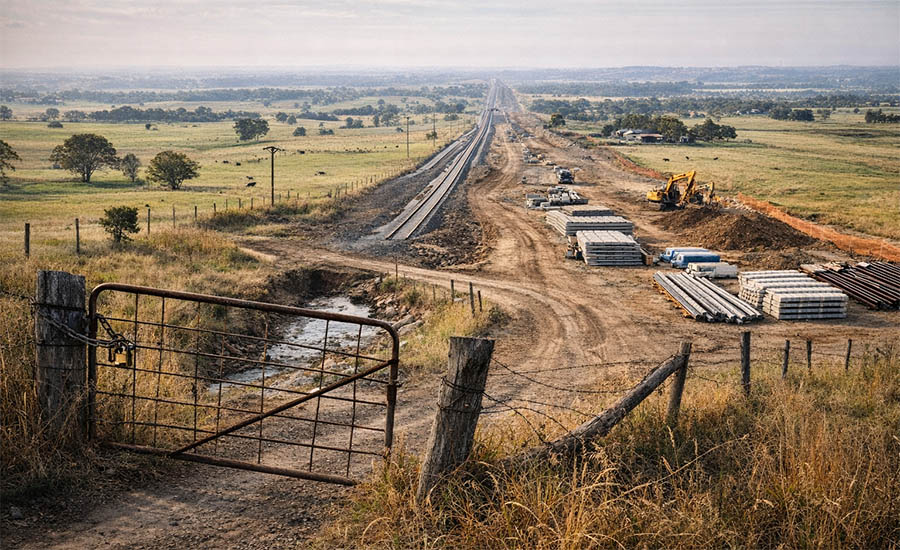
In 2011, the Secretary compulsorily acquired the 28.35-hectare portion for the Regional Rail Link 2 Project. Following negotiations, the market value and severance components of the compensation were agreed upon at $13.75 million.
With a significant corpus of cash now sitting in the Fund, the Stellas faced a dilemma. To avoid heavy taxation and support their retirement, they needed to transition the Fund into 'pension mode', which required assets that produced a high yield. Consequently, in 2013, the Fund purchased a $27.5 million industrial park in Smeaton Grange, New South Wales, using the compensation money combined with borrowed funds.
The Legal Conflict: What is a 'Disturbance' Loss?
The Stellas sought to recover $908,801.32 as 'loss attributable to disturbance'. This claim was comprised of the stamp duty, legal fees, and loan costs associated with purchasing the Smeaton Grange industrial park. They argued that because they were 'forced' to find a replacement asset to maintain the Fund’s objectives, these costs were a direct result of the acquisition.
Under Section 40 of the Land Acquisition and Compensation Act 1986 (Vic), 'loss attributable to disturbance' is defined as any pecuniary loss suffered as the 'natural, direct and reasonable consequence' of the acquisition. To succeed, the dispossessed owner must prove their loss satisfies all three of these adjectives.
The 'Stock in Trade' Argument
In compulsory acquisition law, developer owners are a recognised category of claimants. For these entities, land is considered 'stock in trade'. When a developer’s land is taken, they are deprived of their primary business asset and must incur costs to find new land to develop. In such cases, courts have historically allowed the recovery of costs for searching and investigating replacement land as disturbance.
The Stellas argued their Fund fell into this category. They contended that the Wyndham Vale land was their 'stock,' and by taking it, the Authority had interrupted their business of land development. Therefore, the costs of 'replacing' that stock with the Smeaton Grange properties should be compensable.
The Court’s Verdict: The Power of 'Directness'
Justice Bell